
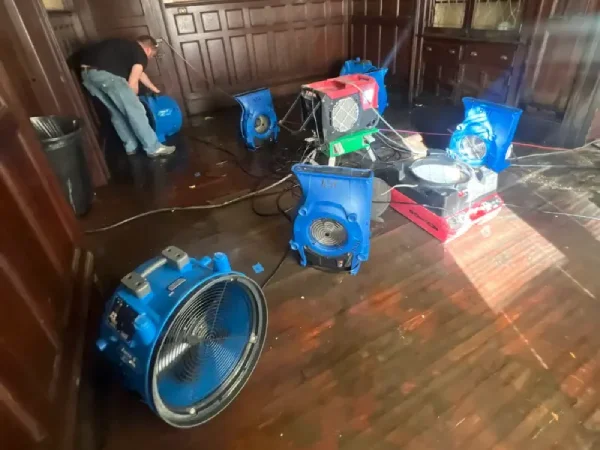
Jonesborough is Tennessee's oldest town. Its historic district, older neighborhoods, and location near the Nolichucky River all affect how water moves around and inside local homes.
Every spring, the same pattern repeats across the region. Winter precipitation soaks the ground. Snowmelt from higher elevations above Elizabethton adds more water to the creeks and streams in the watershed. When spring rains arrive, the soil is already saturated and cannot absorb any more water.
For homeowners in older Jonesborough neighborhoods, that water becomes an immediate threat. It often rushes against foundations, under doors, and into crawl spaces that have aged over the years, demanding urgent attention.
What Spring Flooding Actually Looks Like at the House Level
Regional flooding that closes roads and makes the news is one scenario. But most water damage during wet seasons is less dramatic. It often happens when drainage can't keep up, such as when a yard slopes toward the house, gutters are clogged, a downspout ends too close to the foundation, or a window well fills faster than it can drain.
Just a few inches of standing water pressed against a foundation wall for six hours can quickly push moisture through block or brick into the crawl space. In an older Jonesborough home with a bare-earth floor and a thin vapor barrier, this doesn't just create moisture below—it triggers humidity that rises through the floor, impacting living spaces above. Immediate action is critical to prevent lasting damage.
Sometimes the warning signs are structural: floorboards that suddenly feel spongy, gaps between boards, or doors that stick more with every passing warm day. Other times, a musty smell in first-floor rooms worsens quickly as May and June progress. By the time these signs appear, the crawl space has endured high moisture levels, and damage is already underway. Act fast when these indicators appear.
Historic Homes, Modern Moisture Standards
Washington County and the Jonesborough area have homes from many different eras. Houses built before the 1970s followed very different moisture-management standards, and sometimes had none at all. Crawl spaces were made for ventilation, not vapor control. Walls lacked moisture barriers, and window sealing was not as advanced as it is today. It does mean they need intentional moisture management that wasn't part of the original design. A properly installed crawl space vapor barrier system, functional gutters and grading, and maintained foundation vents can dramatically reduce the risk of water intrusion in an older home.
When an intrusion occurs despite those precautions, the materials involved absorb water differently than modern construction materials. Older dimensional lumber, plaster walls, and original hardwood flooring each respond to moisture in ways that require a tailored drying approach.
How We Approach Water Damage in Older Homes
Our team values the character of older homes in Jonesborough and nearby areas. We take a careful approach to restoration by first assessing which materials are present, how they've reacted to moisture, and which drying method will work best before we begin any work.
Not every older home needs the same strong drying methods used for modern OSB subfloors. Wood that has been in place for 80 years holds moisture differently than new wood, and drying it too quickly can cause damage. We adjust our drying plans to fit each situation.
At the start of every project, we do a full moisture check. This includes taking meter readings of all affected materials, using thermal imaging when needed, and monitoring humidity throughout the building. These steps help us dry the home properly without overdrying.
Homeowners in Bristol, Johnson City, and Elizabethton who face similar spring moisture problems can expect the same local expertise. The Tri-Cities region has unique weather and building styles, and our work is tailored to fit those needs.
Take action before spring flooding damages your home. Schedule a professional crawl space assessment now to identify and fix issues like damaged vapor barriers or drainage problems. Early intervention in March can prevent months of escalating damage and costly repairs later.
If water intrusion has occurred, act now. Spring humidity in Northeast Tennessee rarely allows moisture to dry out naturally, and delaying action increases risk.
Rainbow Restoration of Tri-Cities is ready to help homeowners across Jonesborough, Bristol, Elizabethton, and Johnson City. Call us, visit rainbowrestores.com/tri-cities-tn, or find our team on Google.