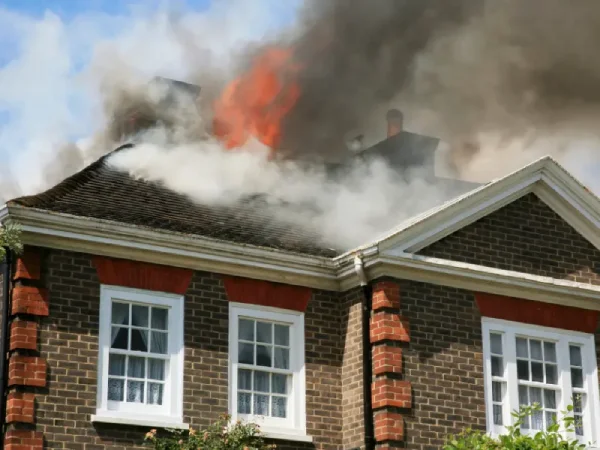
The call came at 11 at night. A candle had been left burning in a bedroom, and when the smoke alarm triggered, the homeowner awoke to discover a nightstand and part of the curtains burning. The fire department arrived within minutes and put it out quickly. Total burn area: one corner of a bedroom, roughly eight square feet of wall and ceiling.
But the house didn't smell like a bedroom fire. It had the scent of a whole-house fire.
Two days later, the smoke odor had embedded itself in the master closet down the hall, the adjacent bathroom, the carpeting upstairs, and the HVAC vents running from that room to every other room. The visible damage was limited. The smoke damage was not.
Why Smoke Travels So Much Further Than the Flames
Fire generates pressure. As heat rises rapidly in a confined space, it drives smoke outward through every available path: gaps around door frames, HVAC return vents, and spaces where electrical wiring runs through wall plates. Smoke doesn't stay in the room where the fire was. It moves through a structure like air, following pressure differences and finding every path of least resistance.
In an Elizabethton home, many of which are older two-story constructions with ductwork running through interior walls, that path often runs straight through the HVAC system. A return vent near the fire's origin can draw smoke into the air handler, redistributing particulates and odor compounds throughout the entire duct system before anyone shuts off the HVAC. By morning, the smell is everywhere.
The type of fire also affects the scope of damage. A fast, high-heat fire produces dry, powdery soot that is easier to clean from hard surfaces. A slow, low-heat fire burning upholstery, synthetic materials, or household items produces dense, oily smoke that penetrates deeply into porous surfaces and is harder to treat. Most residential fires involve both, which is why fire restoration isn't a single, uniform cleaning method.
What the Restoration Process Actually Involves
The first step after a fire is a full-scope assessment — not just the burn area, but every surface, material, and system that smoke may have reached. Soot deposits on walls and ceilings are identified and categorized. Air quality readings and odor testing establish how far smoke has traveled. The HVAC system is inspected to see if the ductwork has been compromised.
Structural cleaning follows, using chemistry and techniques matched to the soot type. Dry soot requires dry cleaning before any wet application — applying a liquid cleaner to dry soot smears it into the surface rather than removing it. Oily wet soot requires different chemistry and multiple passes. Our crew is trained to identify the type of soot and adjust accordingly.
Content cleaning — furniture, clothing, personal items — is handled separately. Some items can be cleaned on-site. Others benefit from off-site processing in a controlled environment.
Odor elimination is where many restoration companies fall short. Spray-on deodorizers and odor-masking agents wear off. Our process uses hydroxyl generation technology to produce hydroxyl radicals that chemically break down the molecular compounds causing smoke odor, rather than covering them up. It takes time and requires structured treatment, but the result is genuine odor elimination, not a temporary fragrance over a persistent problem.
Working Through the Insurance Claim
Fire claims call for careful documentation, and the scope isn't always obvious from the outside. Insurance adjusters assess visible damage, but smoke damage inside ductwork, wall cavities, and embedded in materials like carpet padding and insulation isn't always captured in the first estimate.
Our team prepares detailed documentation — photographs, air quality readings, material assessments — that gives your insurance carrier a complete picture of what the fire affected. Homeowners across Elizabethton, Johnson City, Bristol, and Jonesborough have found this support valuable as they manage the claim process, especially when secondary damage is involved.
We're not advocates in the legal sense — but we know how to communicate the full scope of a fire's impact in terms that move a claim forward accurately.
The Cost of Waiting
Smoke residue is reactive. The longer it sits on surfaces — especially porous materials like drywall, wood trim, and carpeting — the deeper it bonds. What can be cleaned in the first 48 hours may require replacement if addressed two weeks later. Speed is not merely a convenience in fire restoration. It affects cost.
If a fire has occurred in your Elizabethton home, large or small, the right call is to arrange a professional assessment as soon as possible. The clearer the scope and the wider the options, the sooner we can assess it.
Rainbow Restoration of Tri-Cities responds to fire damage throughout Elizabethton, Bristol, Johnson City, and Jonesborough. Call us, visit rainbowrestores.com/tri-cities-tn, or find us on Google.